

How proof of human technology works
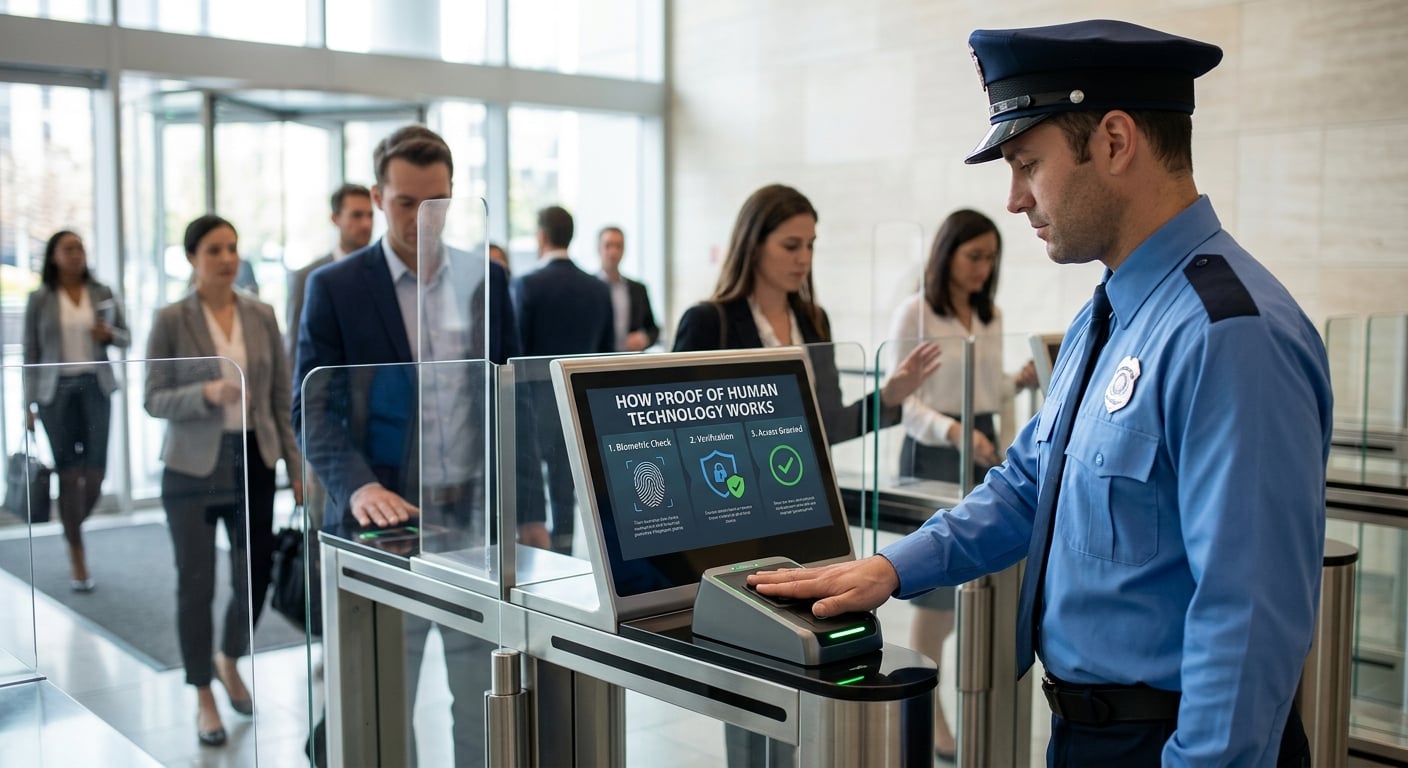
Everyone's calling it the fix for scams, fraud and fake profiles. I wanted to know how it actually works
Lately I keep running into the same phrase: proof of human. It's being talked about everywhere as the answer to the internet's trust problem, the thing that will finally cut down on scams, fraud, fake profiles, and the bot armies that clog up every platform. The pitch is bold: prove there's a real, unique person behind an account, and most of that abuse becomes far harder to pull off.
And honestly, the problem it's aiming at is real. The internet has quietly lost the ability to tell humans from machines. Bots make up around half of all web traffic, AI can generate convincing faces and voices, and the old test, a CAPTCHA asking you to click some traffic lights, is now solved by machines faster than by people. Fake accounts and deepfakes are cheap and everywhere. So a technology that could reliably confirm "yes, this is one real person" would genuinely matter.
But every time I saw it described, it was hand-waved: "it proves you're human, privately." That's the part that nagged at me. How do you prove someone is a real, unique person without making them hand over their identity? That sounds contradictory. So I went and dug into how the technology actually works, step by step, and it turned out to be more clever than I expected.
Here's what I found.
First: what proof of human actually confirms
Before the mechanism, one distinction that the entire thing hinges on, because getting it wrong makes everything else confusing.
Proof of human answers a narrow, specific question: is there a real, unique human here? Two facts, and nothing more:
Real: a living person, not a bot, script, or AI agent.
Unique: one human maps to one proof, so the same person can't show up as a thousand accounts.
Notice what's missing: who the person is. Proof of human is deliberately not the same as proof of identity.
Proof of identity answers "who are you", and needs your name, document, or personal details.
Proof of human answers "are you a real, single person", and is designed to reveal nothing else.
Hold onto that, because the surprising part of the mechanism is how it confirms you're real and unique while learning nothing about you.
The step-by-step: how verification actually works
Here's the full flow, from enrollment to everyday use. The complexity happens once, at setup; using it afterward is nearly instant.
Step 1: One-time verification
The person confirms, a single time, that they're a real and unique human. This is the step that establishes the two facts, real and unique, and it's designed to be hard to fake at scale (that's what makes the "unique" guarantee strong). It happens once, not every time you use the proof.
Step 2: A credential is created, on your device
The verification generates a credential, and crucially, it's stored on the person's own device, not on a company server. This is called personal custody. There's no central vault holding everyone's data, because the sensitive data never gets collected centrally in the first place.
This is the difference between "we promise not to misuse your data" (a policy that can break) and "we don't hold your data to misuse" (a structural fact). The credential lives with you.
Step 3: The uniqueness check, without a central database
This is the first part that genuinely impressed me. To guarantee one-person-one-proof, the system has to confirm you haven't already enrolled. Normally that would mean comparing you against a central database of everyone, exactly the honeypot that makes biometric systems dangerous.
Instead, privacy-preserving techniques (like anonymized multi-party computation) let the system confirm you're new without holding a readable central store of everyone's data. It can answer "has this person enrolled before?" as a yes or no, without keeping the underlying information in a place that could leak.
Step 4: Using it, when an app asks
Now you're set up. When an app or website wants to know you're human, you present a proof from your device. From your side it's a single tap. Behind that tap, the interesting cryptography fires.
Step 5: The zero-knowledge proof
Here's the heart of it. When you prove you're human to an app, the app does not receive your credential, your data, or any identifier that ties back to you. It receives a zero-knowledge proof.
A zero-knowledge proof lets you prove a statement is true while revealing nothing beyond the truth of that statement. The everyday analogy: proving you're over 18 without showing your birth date or your name. Applied here, you prove "I hold a valid proof of human" without exposing anything about who you are. The app learns exactly one fact, valid, unique human present, and nothing else.
Step 6: Unlinkability
The final piece, and the one that I think most people miss, is this. It's not enough to be anonymous, because a system could verify you anonymously and still track you if every use carried the same hidden identifier.
So the mechanism ensures unlinkability: your separate uses can't be connected to each other. Prove you're human on one app, then another, and there's no shared token letting those apps (or the system itself) figure out it was the same person both times. Techniques like one-time-use nullifiers make each proof unlinkable to the others.
That's the full loop: verify once, hold your own credential, prove humanness anywhere with a zero-knowledge proof, and leave no trail that connects your uses.
The three properties that make it work
Step back and the whole mechanism rests on three cryptographic properties working together. Understanding these is the real takeaway, because you can use them to judge any system that claims to be private:
Zero-knowledge proofs let you prove a fact without revealing the data behind it. (Without this, verifying means disclosing.)
Personal custody keeps your data on your device, not a central server. (Without this, there's a honeypot waiting to leak.)
Unlinkability stops your separate uses from being correlated into a profile. (Without this, anonymous still means trackable.)
Miss any one of them and the privacy breaks. A system with zero-knowledge proofs but no unlinkability still lets you be tracked. One with personal custody but no zero-knowledge proofs still makes you over-share. All three, together, are what turn "verified" into "verified and private."
A Real World Example
The most developed real-world implementation of this flow is World ID. It follows exactly the steps above: a person verifies once that they're a real, unique human, the resulting credential is held on their own device under personal custody, and when they use it, a zero-knowledge proof confirms they're a valid, unique human without revealing their identity to the app.
For unlinkability, it uses an open-source protocol (Semaphore) with one-time nullifiers so that, per its documentation, uses can't be tracked across applications. The result is a proof of human, not a proof of identity: an app learns you're a genuine, singular person and nothing else, and can't tie that use to any other.
If you want the concept explained from the ground up, the World Learn Center collects the proof-of-human and privacy-cryptography topics, and the what is proof of human explainer is a good starting point.
What it does, and doesn't, do
An honest mechanism explainer has to mark the edges, because proof of human is powerful precisely because it's narrow.
It confirms a real, unique human is present. It does not confirm that human is honest. A verified person can still lie, run a scam, or behave badly. What proof of human stops is one person cheaply pretending to be thousands, the bot armies, fake-account farms, and Sybil attacks that depend on faking many identities. It raises the cost of that to something real. It is not a character reference for the individual.
It's one narrow claim, deliberately. Because it reveals nothing but "real, unique human," it's perfect for the huge number of situations that need exactly that (keeping bots out, one-person-one-vote, fair access) and intentionally not a fit for cases that legally require knowing someone's real identity, like opening a bank account. That's not a limitation to fix; it's the point.
The short version
Proof of human confirms two facts, real and unique, and nothing else. It's not proof of identity.
The flow: verify once → hold your credential on your own device → prove humanness to any app with a zero-knowledge proof → separate uses stay unlinkable.
It rests on three properties: zero-knowledge proofs (prove without revealing), personal custody (data on your device), and unlinkability (uses can't be correlated). All three are required.
It raises the cost of faking many humans, which breaks bots and fake accounts, but it doesn't vouch for any single person's honesty.
The thing I keep coming back to is the part that sounded impossible when I started: you really can prove you're a real, unique person while revealing nothing about who you are. It's not a trick or a marketing claim, it's three well-understood pieces of cryptography doing exactly what they were designed to do.
Once I saw the machinery, the "prove you're human, privately" line stopped sounding like a contradiction and started sounding like the obvious answer. Whether the whole internet adopts it is another question, but the technology under the hype is real, and genuinely clever.


